


Introduction
The Opportunity Zone Program offers investors three distinct tax benefits — deferral, partial reduction, and the 10-year exclusion — but only if an investor adheres to all the timing and rules of the tax legislation. If you or your tax advisor aren’t clear on when certain steps need to take place, you could miss out on the potential capital gains tax savings generated by a QOZ investment.
Many high-net-worth investors and their advisors are unclear on exactly how opportunity zone investing works. They may also misunderstand the 180-day reinvestment window and how year-end timing works in practice.
And, with the recent codification of the qualified opportunity program under the One Big Beautiful Bill Act (OBBBA), there are new considerations that investors need to understand. But whether the new rules apply depends on when you first invested in a qualified fund.
This guide breaks down opportunity zone tax benefits, including deferral, partial reduction, and the 10-year exclusion, helping investors make informed decisions before they run into filing deadlines. For investors who previously deferred capital gains through a QOF, it’s worth noting up front that December 31, 2026 is a hard deadline: those deferred gains become taxable on that date regardless of whether the investment is still held.
Whether you are a seasoned real estate investor, new to qualified opportunity zone investing, or an advisor working with a client on a liquidity event, this resource will help you understand both the tax benefits and the requirements of investing in a qualified opportunity zone.
What Is a Qualified Opportunity Zone?
Qualified opportunity zones (QOZs) are economically underinvested census tracts designated by the IRS originally under the Tax Cuts and Jobs Act of 2017, and now amended per the OBBBA tax legislation of 2025. Each opportunity zone designation is tied to a specific census tract nominated by state governors and approved by the U.S. Treasury. There are currently over 8,700 of these zones, and the OBBBA established a rolling period for the creation of new zones. New tracts will be designated at regular intervals for the expansion of the program. The next zone update will be effective as of January 1, 2027.
There’s an important distinction between a QOZ and a qualified opportunity zone fund (QOF). The former refers to a specific census tract. The second is a specially structured investment vehicle that allows investors to invests in the designated areas and take advantage of the opportunity zone tax benefits.
Investors place eligible short term or long-term capital gains—such as those from the sale of stocks, businesses, real estate, or cryptocurrency—into the funds. The funds then let the investor take advantage of the specific QOZ tax benefits, which we’ll discuss shortly.
This program was designed to channel private capital into underinvested communities in the United States in exchange for preferential federal tax treatment on capital gains. (It’s worth noting that not all states align with the federal rules on QOZ investments, so it’s a good idea to check with a CPA or tax advisor about how your state taxes capital gains.)
Who Qualifies For Opportunity Zone Tax Benefits and What Gains Are Eligible?
It’s so important that it’s worth saying again: only capital gains, not ordinary income, are eligible for reinvestment into a QOF. Both short- and long-term capital gains qualify, but the tax treatment of each differs before you reinvest them.
Crucially, you have 180 days from the realization of the capital gain to reinvest it into a qualified fund. You don’t need to invest the entire proceeds of the sale, just any portion of the capital gain. The 180-day rule has some slight nuances depending on the type of sale that generates the capital gain. For example, partnerships, S-corporations, and other pass-through entities may let you start the window slightly later than a stock or real estate sale.
(It’s worth noting that, because of the 180-day window, capital gains from as early as July 2026 (January 1, 2026 for pass through entities) may be eligible for investment under the new rules, outlined in the OBBBA, that take effect in January 2027).
The details of these rules make consulting with a tax advisor critical: if you miss the applicable investment window, your gains are no longer eligible for qualified opportunity zone tax benefits.
Any U.S. taxpayer is eligible to invest in a qualified opportunity zone, including high-net-worth individuals, family offices, and business owners receiving proceeds from a liquidity event.
Understanding the reporting requirements for QOF investments, including Form 8997 for tracking deferred gains, is an often-overlooked part of year-end planning.
What Are The Opportunity Zone Tax Benefits?
Under the new QOZ rules detailed in the OBBBA, there are three main opportunity zone tax benefits: capital gains deferral, a step-up in basis (reducing the capital gains taxes due in the fifth tax year), and the 10-year exclusion. Here’s what you need to know about each:
1. Capital Gains Deferral
The first and most immediate benefit of a QOZ investment is a deferral of capital gains tax payment. By reinvesting eligible capital gains into a QOF, investors postpone federal tax liability until either the earlier of sale of the QOF interest or five years from the date of investment.
This deferral applies regardless of when you invest in a QOF and gives an investor five years of tax-deferred growth on invested capital. This makes the QOZ investment particularly appealing to investors with large capital gains events.
Capital gains from July 2026 (January 1, 2026 for pass-through entities) and later are eligible to be invested under the second OBBBA version of the program, letting investors access the new, rolling five-year deferral period. Talk to a tax advisor or a fund manager if you’re not sure how to take advantage of the new program or if it’s unclear which tax benefits are available to you based on your capital gain timing.
The amount of gain eligible for deferral is not limited, making Opportunity Zone investing an attractive strategy for investors recognizing significant capital gains.
Under both the original and the updated program, the reinvested capital remains fully at work and invested in the QOF during the deferral period.
2. Step-up in Basis
The second benefit requires holding a QOF interest for at least five years but potentially provides even more advantages.
It’s important to understand the two different versions of this rule.
Under the legacy QOZ program:
Investors who hold a QOF interest for five years prior to the December 31, 2026 tax deadline receive a 10% step-up in basis on the original deferred gain. If held for seven years, an investor received a 15% step-up in basis on the original deferred gain. In short, this means 10% or 15% of the gain is excluded from federal taxes. Because the 2026 inclusion date is fixed, you won’t be able to take advantage of this benefit unless you invested before December 31, 2021. (Though some gains made in 2026 and reinvested are eligible—see below.)
Under the new QOZ program established by the OBBBA:
Investors who hold a QOF interest for five years receive a 10% step-up in basis on the original deferred gain. Those who invest in the newly established Rural Qualified Opportunity Zones for five years receive a 30% step-up in basis.
This is a very powerful benefit available to investors, but the timing of the five-year period and the establishment of the new program require attention to detail. Because of the 180-day reinvestment window, investors who realize a capital gain after July 2026 (January 1, 2026 for pass-through entities) may be able to invest under the new OBBBA program in a QOF after January 1, 2027, and maintain eligibility for the five-year step-up in basis under the permanent program outlined in the OBBBA.
This is an especially important factor to discuss with your tax advisor, as the tax benefits can be significant, and mistiming your investment could lead to you losing out.
3. The 10-Year Exclusion
For long-term investors, the potential exclusion of appreciation could be a significant component of the tax benefits available. Investors who hold their QOF interest for at least 10 years eliminate all federal capital gains tax on the appreciation generated within the fund, including no recapture of depreciation.
Let’s imagine, for example, that an investor puts $500,000 of capital gains into a QOF. Over 10 years, that investment grows to $1.2 million. That $700,000 of appreciation is completely excluded from federal capital gains tax.
Keep in mind that this only excludes the appreciation—not the original capital gain—from federal taxes. You’ll still have to pay taxes on the original gain (minus the discount). This is currently recognized at the inclusion date during the fifth tax year.
Investors must elect the step-up in basis to fair market value at the time of sale to claim the 10-year exclusion, typically done on Form 8949.
For real estate-focused QOFs and QROFs with strong appreciation potential, this benefit alone can represent a huge difference in after-tax returns compared to traditional investment structures.
Fortunately, this benefit remains available to QOF investors under both programs.
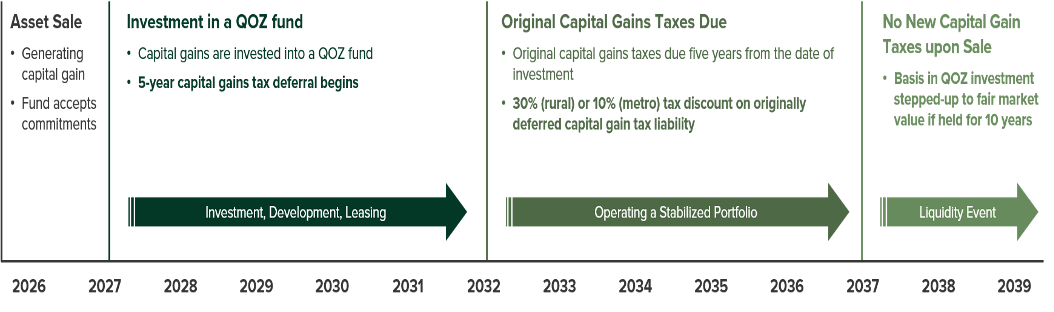
The Timeline: How the Three Benefits Layer Together
Trying to keep track of the different timelines and qualified opportunity zone tax benefits is a challenge (that’s why it’s important to work with a CPA or tax advisor if you’re considering investing in a QOF). To simplify things a bit, we’ve broken it down for you below:
Investments Made Before January 1, 2027 (QOZ 1.0 rules)
- Day of Gain: Capital gain recognized and 180-day investment window begins.
- Within 180 Days: Gain invested into a Qualified Opportunity Fund.
- December 31, 2026: Deferred gain generally becomes taxable under the legacy Opportunity Zone rules.
- After 10 Years: Appreciation generated inside the QOF may qualify for the federal capital gains exclusion upon sale, provided all program requirements are satisfied.
Investments Made Beginning January 1, 2027(QOZ 2.0 rules)
- Day of Gain: Capital gain recognized and 180-day investment window begins.
- Within 180 Days: Gain invested into a Qualified Opportunity Fund.
- Five-Year Holding Period: Deferred gain generally recognized after the rolling five-year deferral period, with qualifying investors eligible for the applicable basis step-up.
- 10-Year Holding Period: Appreciation generated inside the QOF may qualify for the federal capital gains exclusion.
Please note: Investors committing to a QOZ 2.0 Fund today should not have their capital called and invested until January 1, 2027.
Common Misconceptions About QOZ Tax Benefits
The tax incentives behind the Qualified Opportunity Zone Program are significant—but they can also be somewhat complicated. There are quite a few misconceptions about them. We’ll clear up six of those misconceptions here.
Misconception: You must invest the full proceeds from an asset sale.
In reality, the capital gain — not the full sale proceeds — is the only amount eligible for reinvestment to receive deferral treatment. If you sell a property for $500,000, and $300,000 of that is principal, while $200,000 is a capital gain, any portion of the capital gain is eligible for reinvestment (in this case, up to $200,000).
Misconception: The basis step-up is no longer available to new investors.
Investments made under the permanent version of the program (beginning on January 1, 2027) are still eligible for the 10% step-up after five years and investments in a Rural QOZ Fund earn a 30% step-up in basis.
Remember that 180-day eligibility window means capital gains earned in July 2026 (January 1, 2026 for pass-through entities) or later can be reinvested after January 1, 2027, so some capital gains from 2026 are eligible for the basis step-up.
Misconception: Any fund operating in an opportunity zone qualifies.
A fund must meet specific IRS requirements to be certified as a Qualified Opportunity Fund or Qualified Rural Opportunity Fund, and investors should request documentation confirming QOF status. (see our overview of Section 1231 gain timing rules).
Misconception: State capital gains taxes are also deferred.
A few states do not conform to federal QOZ deferral provisions, meaning those state-level capital gains taxes may still be due in the year of the original sale. As always, working with a CPA or tax advisor will clear up questions like this.
Misconception: The 10-year exclusion protects the original capital gain.
This is an important one; the 10-year exclusion only excludes appreciation generated inside the QOF. That means the original deferred gain remains taxable at the fifth-year deferral established by the OBBBA—minus any step-up in basis.
Misconception: Investing before December 31, 2026 allows investors to receive the new five-year rolling deferral and basis step-up created under OBBBA.
In reality, the enhanced five-year deferral and basis step-up under OBBBA apply to investments made beginning January 1, 2027 — not to the date the capital gain was realized. An investor can realize a gain in 2026 and still qualify for the new framework, but only if the reinvestment itself occurs on or after January 1, 2027, within the applicable 180-day window. Investing earlier, under the legacy program, does not carry these enhanced benefits.
Year-End Action Steps for Investors and Their Advisors
The end of the year is an important time for all investors—but it’s even more important if you’re trying to take advantage of opportunity zone tax benefits. The deadline for making reinvestments is strict and can’t be missed.
Whether you’re considering investing in a QOF or QROF (or advising a client on the idea), here are the steps you should be taking as the end of the year approaches:
- Identify all capital gain recognition events from the current tax year. Calculate the exact 180-day reinvestment deadline for each eligible gain. (Keep in mind that different pass-through entities may allow you to defer the beginning of the 180-day window).
- Begin qualified opportunity zone fund due diligence. Fund onboarding, subscription documents, and capital transfers all take time, therefore from a timing perspective it is important to be prepared in anticipation of capital gains events.
- Evaluate whether a standard QOF or a QROF (for rural investment) better fits your goals, given the differing step-up percentages and improvement thresholds.
- Document all investment decisions and deadlines. This documentation supports accurate tax reporting on Form 8949 and helps satisfy the required inclusion event disclosure.
- Note the expanded reporting requirements for Qualified Opportunity Funds and investors under the current program, which make accurate documentation more important than under the original legislation.
Advisors should also proactively reach out to clients who had significant liquidity events throughout the year (especially Q3 2026 or later). Identifying eligibility for QOZ investments early helps get investors maximize opportunity zone tax benefits before the end-of-the-year rush.
How Peakline Real Estate Funds Can Help You Capture These Benefits
Peakline Real Estate Funds specializes in qualified opportunity zone real estate investments, with $1.2 BB in committed equity across 18 investments across multiple US markets. These investments are supported by a platform with deep investment, construction, compliance, asset management, and reporting capabilities. These funds are designed for high-net-worth investors seeking both tax efficiency and strong risk-adjusted returns.
The Peakline QOZ IV Program comprises a Metro Fund and a Rural Fund, both now accepting commitments from accredited investors. Each pursues a disciplined real estate strategy in opportunity zone markets Peakline believes are positioned for long-term growth, with a structure designed around the potential 10-year appreciation exclusion available to investors who meet the holding requirements.
If you’re approaching a year-end capital gains deadline, it’s a good time to request the QOZ IV program details. That way, you can evaluate how well it fits your situation and goals, review legal documents, and begin the subscription process before the end of the year.
Advisors who regularly work with clients on tax-advantaged real estate strategies are encouraged to contact the Peakline Real Estate team directly to discuss co-advisory structures and client referral resources.
Visit the Peakline QOZ IV program page or contact the investor relations team today to take the first step toward turning a taxable gain into a long-term, tax-advantaged real estate investment.
Disclosures:
Any hypothetical examples presented are for illustrative purposes only and do not represent actual or expected investment performance. Actual investment results will vary and may result in a loss of principal.
Peakline Partners, LLC is an SEC-registered investment adviser. Peakline provides investment advisory services strictly to investment vehicles investing in private capital, real estate, venture capital, and other investment opportunities.
The information provided is for educational and informational purposes only and does not constitute investment advice and should not be relied on as such. It should not be considered a solicitation to buy or an offer to sell a security. It does not take into account any investor’s particular investment objectives, strategies, tax status or investment horizon. You should consult your attorney or tax advisor.
The views expressed are subject to change based on market and other conditions. This material may contain certain statements that may be deemed forward-looking statements. Any such statements are not guarantees of future performance, and actual results or developments may differ materially from those projected.
Investing involves risk, including the risk of loss of principal. Investments in real estate and private investment funds involve additional risks, including illiquidity, limited operating history, economic and market conditions, changes in property values, financing risks, and other risks associated with the ownership and operation of real estate. There can be no assurance that any investment will achieve its investment objectives or generate positive returns.
Qualified Opportunity Fund investments involve additional risks and requirements. The availability and extent of any Qualified Opportunity Zone tax benefits depend on an investor’s individual circumstances and satisfaction of applicable statutory and regulatory requirements, including investment and holding-period requirements. Tax laws and regulations are subject to change, and there can be no assurance that any particular tax treatment or benefit will be available. Investors should consult their own tax and legal advisors regarding the tax consequences of any investment.